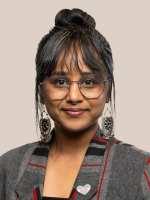
It was nothing short of a Diwali miracle when Parivar Bay Area held its official reopening on November 8th. Co-founder Anjali Rimi expected 20 to 30 people. More than 350 came.
“I can’t even put it in words, how symbolic it was that our light was not diminished and we came out of darkness,” Rimi said. “It just felt like … we’re still worth existing.”
It was a long way from September, when Parivar, the only South Asian transgender organization in the country, was days from closing for good. Now it has a new home at St. Mark’s Square in San Francisco’s Cathedral Hill, a city lifeline of up to $150,000 and a celebration to mark it.
“To have such a festival inside an auditorium that had all the stained glass portraits of the church from 1895 and to see … that with the Lakshmi Puja happening in there. I mean, what else is more real, genuine … interfaith solidarity?,” asked Rimi
The church reached out after reading about Parivar’s situation in the newspaper and offered them the new space. This forged the way for Parivar’s continued existence in the city, albeit smaller than it was, and with some of its most important work on hold.

The vote
In the last days of September, San Francisco's Board of Supervisors finally voted on the backpay Parivar was owed.
The item read to “retroactively authorize the Human Rights Commission to execute a grant amendment... for the Parivar Bay Area... to increase the grant amount by $150,000, for a total amount of $450,000.”
The board voted unanimously in favor, with no debate, but founder Anjali Rimi says getting there took weeks of pushing the Mayor's Office, the Office of Transgender Initiatives and the Board of Supervisors.
"We are now in a place where the resolution unanimously passed," said Rimi, "which is truly, truly a lifeline that we needed to rebuild Parivar Bay Area in San Francisco to continue our impact."
Most of the money is a reimbursement tied to a Human Rights Commission grant for work Parivar finished two years ago. Rimi credited Board President Rafael Mandelman as a champion.
Parivar’s offices were located in District 5, Supervisor Bilal Mahmood's jurisdiction. Mahmood voted in support of the backpay, but Rimi said had not responded to Parivar's outreach during this year's budget advocacy season when Parivar was hoping to retain their original space.
KALW reached out to Supervisor Mahmood’s office for comment.
Losing the space
The funding came too late to save Parivar's Turk Street office, which the group opened less than a year ago.
"We have lost our Parivar Immigrant Cultural Center space because we could no longer sustain the rent, given the lack of any grants or funding, but also because the landlord needed to increase the rent, given all circumstances that he was facing," Rimi said.
Volunteers packed the month after the vote. Rimi said the office had once held legal clinics, a Christmas party, an immigrant leadership graduation and a Diwali celebration.
"People had found this oasis to just come and be, celebrate their culture, belonging, and themselves while receiving support," she said.
For people who know Parivar’s work, the stakes went beyond one building. Dhiraj Korwani, a performer who has collaborated with Parivar since 2019, said losing the organization now would hit trans people at a dangerous moment.
"If Parivar was to go away during this time, that would mean a win for the side that is trying to crush them,” said Korwani. “I’ve seen the impact, I’ve seen why this organization needs to continue to exist.”

A smaller footprint
Rimi said Parivar's budget has shrunk from $1.1 million to about $190,000 for the rest of this year. The organization became an official nonprofit earlier this year, ending its reliance on fiscal sponsors, and plans to diversify its funding across state grants, foundations, corporate partners and individual donors. Rimi said Parivar's board has not decided whether to seek city funding again.
"We are not simply recreating old Parivar," Rimi said. "We learned that impact alone doesn't mean sustainability or guarantee it."
Parivar's new space is in District 2, which Rimi said makes it the first trans, queer and South Asian nonprofit in the area. The office is smaller than Turk Street, with no room for walk-ins or a legal clinic.
Parivar is still waiting on city funds, and it is not offering immigration legal services. Before the closure, those services were its number one offering for Kinnar and Hijra people from the Global South. Rimi said many applicants' identities don't fit the male or female boxes on government forms, and that explaining a third gender recognized in India to a federal immigration system can be difficult.
"It's the cultural humility and understanding of what it takes to hold that identity rather than just be the mainstream transgender person," Rimi said. "And that is something that they might not have if they go elsewhere."
For now, Parivar refers people to mainstream lawyers. Rimi said the organization has continued to step in during crises, speaking with doctors and therapists on behalf of Kinnar and Hijra patients with their permission.
Parivar plans to announce its immigrant emerging leadership program by the end of November and begin taking applications, though it will look different from before.
"It's not just about opening our doors," said Rimi. "It's also about keeping our doors open."