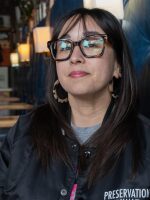
The Golden State Valkyries are known for embracing their queer fandom. But the WNBA wasn’t always so accepting. It took years of pushing for change to get where we are today, both from the outside by fans, and from people within the teams.
One pivotal moment came out of the Valkyries’ Northern California predecessors, the Sacramento Monarchs. When a lesbian group still faced homophobia at the hands of the franchise, they decided to do something about it — and made history.
Click the play button above to listen!
Story Transcript:
REPORTER: I fell in love with basketball when I was 9 years old. I started sleeping with a ball next to my head and wearing giant shorts to my knees. My obsession was rabid, impossible to satisfy. But I had no interest in the Golden State Warriors, who played in Oakland where I lived.
To me, watching men play basketball was the watered down version of the game I was learning — women’s basketball. I wanted the real deal. I wanted the WNBA.
So in 1999, my family began making this summer pilgrimage out of town. My dad would let me get onion rings from the Burger King on Broadway, and for the long drive I’d request Blue by Eiffel 65 — on repeat.
Then we’d set out — an hour and a half drive, beyond the bridges, to where the land flattened and paled. I can still feel my excitement, my shorts stained with ketchup, as we approached Arco Arena. It was in the middle of nowhere, fields on all sides, but to me it was the ultimate basketball mecca — full of fans screaming for our team, the Sacramento Monarchs.
ESPN BROADCASTER: Game is over, Sacramento has won!
Most of the fans were women: wearing bulky tank tops and short pixie cuts, sometimes dyed a regal purple. They reminded me of the lesbian moms I knew in Oakland, except way more intense, like they could wrestle or outrun someone at any moment. And they believed in the Monarchs, a team that got better and better, year after year, until 2005 — when they won Sacramento’s first-ever pro basketball championship.
ESPN: It is over! Sacramento wins for the first time in WNBA history!
By then, I was in high school. I’d replaced my tomboy basketball shorts with tight jeans.
And I’d also started to feel avoidant about my interest in women’s basketball, like it meant something shameful — about me. I felt this when the guys at my high school pulled me aside with mock concern, asking whether I knew that playing in the WNBA meant you were a lesbian. It’s a trap! My mind told me. “I’m not gay,” I said, but they cackled anyway.
After my first year of college, on the back of a winning season, the Monarchs owners made a shocking announcement: they were folding the franchise.
TICHA PENICHEIRO: I’m still heartbroken on the way that we folded. Obviously it was unexpected and we were kinda blindsided.
REPORTER: That’s former Monarchs point guard Ticha Penicheiro.
PENICHEIRO: But my first thought were: what about these fans? We didn’t have a chance to say goodbye, we don’t know if they’re gonna bring another team here.
REPORTER: They didn’t. The WNBA wouldn’t return to Northern California for another two decades. Until Golden State revived a purple uniform — this time a shade lighter, calling it violet.
By then, a lot had changed in my own life, too. In my 20s, when I first articulated myself as queer, being a WNBA fan became a lifeline to this identity. I found a space of refuge and acceptance as I worked through my own internalized homophobia and shame. In my 30s, when I finally started dating women, I also began writing full-time about women’s basketball.
By 2025, I was back in the Bay covering the Golden State Valkyries as they played in sold-out arenas. I loved how much the Valkyries actively embraced their gay fans. The jumbotron showed queer parents waving with their kids and queer couples kissing passionately. Fan groups, like the ValQueeries, gathered outside before games.
Queer community has even become synonymous with the team’s success. It sounds like this, from a post-game interview with star Gabby Williams.
MATT LIVELY: You had 13 points in this fourth quarter, you had a big steal, what came alive down the stretch for you?
GABBY WILLIAMS: I couldn’t lose on pride night, that’s what I kept telling myself.
REPORTER: Gabby wanted to win for the queer community, or as she said…
WILLIAMS: For the gays! For the gays!
REPORTER: For the gays.
But a question lingered with me: how, exactly, had Ballhalla become so recognizably queer? And was there a connection between queer Valkyries fans today and the queer Monarchs fans I saw growing up?
When I went digging, I found something even more surprising in Sacramento: a specific blueprint of change, and a story that has made me hear this viral chant —
CROWD: For the gays! For the gays! For the gays!
In a whole new way.
ANDREA LEPORE: Alright, my name is Andrea Lepore.
REPORTER: Her career began in 1990, when she started an internship with the Sacramento Kings as an undergrad at UC Davis. Within a few years, she became an executive with the team, in a world dominated by men.
LEPORE: It was difficult too, being — essentially, in almost every situation — being one of the only women there.
REPORTER: Andrea loved her work in the NBA, but a women’s league?
LEPORE: Yeah, I don’t really recall thinking that this was even possible at the time.
REPORTER: All of that changed in the mid-1990s, when then-NBA commissioner David Stern announced: it was time for a women’s league. Stern wanted to capitalize on the growing interest in women’s basketball… and he saw a business opportunity for the NBA. Each new team would be run by an NBA franchise. The Sacramento Kings were one of 8 teams who responded to the call.
LEPORE: You know, I still have the ball that says Sacramento, the date when we were awarded the team, and just, sort of being shocked that it was actually gonna happen and be a reality. And how fortunate I was to work on something this historic from the start. And I looked at it as this opportunity to showcase women. You know, we had this platform that we never had before.
REPORTER: Andrea was under a ton of pressure. She was building a new team, and she needed to be scrappy.
LEPORE: To essentially oversee, run — oversee sounds like I'm managing a bunch of people. I was doing it all myself, primarily.
REPORTER: Andrea was only 27. After the first season in ‘97, one of the owners came to her directly, and told her…
LEPORE: The league had told him that, you know, that they needed to increase attendance or else we’d be in jeopardy of losing the team. And so he was like, ‘here you go.’
REPORTER: Like, ‘its up to you!’
LEPORE: Yep!
REPORTER: That’s when Andrea kicked into high gear.
LEPORE: So it was basically a year of no days off.
REPORTER: Between 1998 and 1999, the Sacramento Monarchs were the only team in the WNBA to increase their average regular season attendance. And they did it by over 30%.
LEPORE: Val Ackerman, who was our WNBA president at the time, called me into her office in New York, and I was very nervous. And I knew Val, and Val was great, but I was like: ‘Why does she want me to come to her office, am I in trouble, what’s happening?’ So she literally took out a piece of paper that showed all the teams and they were all going in the negative, and we were the only team that was going in the positive. And she was like, "What are you doing in Sacramento?”
REPORTER: As it turns out, Andrea had been doing a lot.
LEPORE: You know, I decided, you know, I wanted to make the players larger than life. So we did huge billboards, like literally Ticha and Ruthie, literally towering over… We did bus wraps… And you know, we did direct mail… Two players would have to sign autographs after games. It’s like literally (laughing) going door to door… Where it was almost like, almost like Tupperware party strategy, where we’d actually go to a season ticket holder’s house, they would invite friends, we’d bring a player and -
REPORTER: You were you literally taking the players there?
LEPORE: Oh yeah.
REPORTER: I know — it’s wild to imagine players just showing up at your house. In Sacramento, Andrea embraced the players’ personalities.
LEPORE: And they were way more interesting than the NBA players, frankly!
REPORTER: And she understood something crucial — you couldn’t take the NBA’s approach to marketing and apply it to the WNBA. The leagues had different fanbases.
LEPORE: Oh yeah, it was definitely heavy female, and not, you know, similar to what the Valkyries are seeing, it wasn't a crossover from Kings season ticket holders, Kings fans. It was a whole new fan base.
REPORTER: Many of whom had never been to a pro basketball game, period.
LEPORE: For a lot of our fans, it was their first experience at a professional sporting event and so we wanted to obviously make sure they had the best time possible.
REPORTER: So Andrea made a point to do things differently.
LEPORE: Just celebrating individuals that weren't always celebrated the way male athletes were… or males period, you know.
REPORTER: And that went beyond the athletes.
LEPORE: You know, one time we had the women’s caucus from the state capital.
REPORTER: Andrea hired women in prominent positions, like radio personality Tina Macuha, as the on-court host. Everything to make women the main characters. In those early years, between 70 to 75% of people who attended WNBA games were women. And Andrea knew: within that, there was a core contingent of lesbian fans.
LEPORE: They were the ones showing up at the autograph signings and at our rallies and at the airport and just publicly very vocal.
REPORTER: But in the 90s, homophobia had a hold on women’s basketball. There weren’t any Pride celebrations at games, and no one playing or coaching in the league was publicly out. This became known as the WNBA’s “glass closet” era. For players, there seemed to be an unwritten “don’t ask, don’t tell” policy. And while lesbian fans were showing up for the WNBA, the league was ignoring them. For many of those fans, this was hurtful, but it was also the status quo.
Andrea was especially aware of this dynamic because she is a lesbian. Back then, she wasn’t out at work.
LEPORE: Yeah, you know, I was just I was closeted, like everyone. So, yeah, it just was a totally different time.
REPORTER: She was frustrated by the WNBA too, especially because she felt they played up the straightness of their three stars:
LEPORE: Just the league overall, even when the WNBA first started, it was like Lisa Leslie, Rebecca Lobo, and Sheryl Swoopes, and they didn't really promote any other players than that.
REPORTER: These three hit certain talking points — the model, the girl next door, the married expectant mother — choices that felt intentional to Andrea. In 2000, the league even put out a press release, listing every recently married player and the name of their husband.
LEPORE: I’m sure they, the league, had a lot of internal conversations about this that they did not talk to the teams about.
REPORTER: But in Sacramento, Andrea took matters into her own hands.
LEPORE: At the time there were actually two gay newspapers, one was called Outword, which is still around, and then there was another one called Mom Guess What, and so we would run ads in both of those.
REPORTER: And while the Monarchs weren’t explicit about what they were doing, Andrea felt everything she did, from hiring women at center-stage to celebrating their power across industries, had created an inclusive environment.
LEPORE: Every night was gay pride night, you know what I mean? Just like every night was women’s empowerment night.
REPORTER: Which made it all the more surprising when, in the year 2000, the Sacramento Monarchs made headlines — for being homophobic.
LEPORE: I was just shocked that we were sort of making, we made a problem when there shouldn't have been a problem.
REPORTER: The story doesn’t start at a Monarchs game, or even in Sacramento, but twenty minutes down the road, through the rice fields, in the college town of Davis. While Andrea was working round the clock to make WNBA fans of all kinds feel welcome, the most unlikely group of people was about to change the course of the league’s history.
SHELLY CROUSE-MONAREZ: Okay, hello, my name is Shelly Crouse-Monarez.
REPORTER: Just like Andrea Lepore, Shelly went to UC Davis, but she chose to stick around.
CROUSE-MONAREZ: After I graduated I was casting about. Kind of going, what do I want to do with my life, you know?
REPORTER: Her social life revolved around one local group, the Davis Dykes.
CROUSE-MONAREZ: It was an actual organization that had get-togethers, and did things. A social group and an activist group and a lesbian connection. You know, I did meet a couple of girlfriends through the organization.
REPORTER: Shelly volunteered for the group, sending out weekly emails to the Davis Dykes listserv, very Y2K.
CROUSE-MONAREZ: You know, there were lots of independent-minded women in the group, which was a strength of the group.
REPORTER: At the time, Shelly, who is proudly bisexual, felt alienated from a lot of homogeneous lesbian groups.
CROUSE-MONAREZ: Women in straight-looking women relationships. And so, “oh, she's the top, I'm the bottom. Oh, she's the husband, I'm the wife.”
REPORTER: Shelly wanted the Davis Dykes to be different.
CROUSE-MONAREZ: I was trying really hard to include bisexuals, I was trying really hard to include trans. And one of my passions for the group is, since I'm bisexual, I wanted to make sure that people understood that there were B’s in that, and that there were T’s in that. You know, and so trying to pry that into the year 2000?
REPORTER: And that meant getting political.
CROUSE-MONAREZ: You want lesbians and bisexuals and trans women to be opinionated. You want them to be active. You want them to be instigating things. Which absolutely, absolutely, this is a movement that we've needed instigators.
REPORTER: The Davis Dykes were there for each other, lifting up one another’s accomplishments. So when one of their members finally got their doctorate, the Davis Dykes wanted to celebrate.
CROUSE-MONAREZ: We were like, “hey Martin, we gotta do something! What do you want?” And they’re like, “just take me to a Monarchs game.”
REPORTER: Some Davis Dykes were season ticket holders.
CROUSE-MONAREZ: And so there were a bunch of people who were like, “woohoo! I already have tickets. Yes, I’ll be with you.”
REPORTER: But many others, like Shelly, had never been to a Monarchs game before.
CROUSE-MONAREZ: Oh gosh, most of us, yeah, like at least our first or second game.
REPORTER: Exactly the demographic of newbies that Andrea hoped to welcome. Shelly says one member had an idea to get group tickets at a reduced price.
CROUSE-MONAREZ: And you get Monarchs t-shirts for your whole group. And of course you get a discount, you get the group’s name in the Diamond Vision. The Diamond Vision, it’s the, you know - that big huge video monitor in the center of Arco Arena, which is pretty awesome!
REPORTER: But when a member of the Davis Dykes called the Monarchs to buy the group tickets, there was a problem.
CROUSE-MONAREZ: The language of the problem was we cannot put your name up on the Diamond Vision because it contains an offensive term — dykes.
REPORTER: The group was furious. They were well aware the term “dyke” to describe lesbians had begun as a slur. But by the late 90s, queer women had been taking the word back — for years. The Davis Dykes had chosen their name as a conscious act.
CROUSE-MONAREZ: And we knew we were reclaiming it for our own power.
REPORTER: They saw it as a direct response to homophobia.
CROUSE-MONAREZ: When you embrace a word, you put your, you take it for your own power, and it no longer has the power to punch you down.
REPORTER: But in order to get their name on the jumbotron, they had to change it.
CROUSE-MONAREZ: Well obviously all of us were in opposition to changing the name. And it got pretty heated because a lot of us feel pretty passionate about the term dykes.
REPORTER: The group went back to the Monarchs. What about the Davis Lesbians? The ticket rep came back: no, no “lesbians” either. He reported the higher ups had nixed that option, and suggested an alternative: Davis Divas.
Shelly and her friends were irate. One later said “Maybe we should call ourselves, the Women Who Dare Not Speak Their Name.”
A few people even resigned from the group during the process. And Shelly remembers that there was so much disagreement about the name over email, it took one member stepping in to say…
CROUSE-MONAREZ: Y’all, stop arguing or I’m gonna play Lady of Spain on my accordion outside your windows at 4am!
REPORTER: Finally, the group settled on Davis Rainbow Womyn — womyn with a ‘“Y.”
CROUSE-MONAREZ: We all kind of held our noses and went with it.
REPORTER: And they went to the game, determined to make the most of it.
CROUSE-MONAREZ: It was a lot of fun because we chose to have fun, we chose to kinda go whatever, and we dealt with it and we moved on. And Martin had a fabulous time.
REPORTER: But the Davis Dykes weren’t pushovers. They were instigators. They didn’t accept the status quo of the WNBA’s glass closet. They were going to blow things up.
Two older members knew the drill.
CROUSE-MONAREZ: They had the Rolodex with all of the media contacts.
REPORTER: So they reached out to the local press, with this story of the discrimination at the hands of the WNBA.
CROUSE-MONAREZ: Oh yeah, they immediately got on the horn with the Sacramento Bee.
REPORTER: That’s when Andrea Lepore heard about what was going down. She’d been out of the office for the last few days, at the 2000 WNBA All-Star Game in Phoenix. She was in the airport when she found out.
LEPORE: I think from a reporter first. I think it was a voicemail, is what I got. I listened to the voicemail. I was like, ‘what is he talking about?’
REPORTER: In past seasons, Andrea would have known exactly what the reporter was talking about. It’s possible she could have prevented this whole thing in the first place.
But the year before, in 1999, the Sacramento Kings and Monarchs had been sold to new owners, the Maloof Family. And while Andrea had a positive working experience with the Maloofs themselves….
LEPORE: They hired a president, and he brought in other new executives that you know wanted to put their stamp on things. Just a different perspective, very male dominant, and just a very different culture than what we had before.
REPORTER: Andrea felt cut out of key decisions and devalued at the Monarchs.
So in July of 2000, when she got that call about the Davis Dykes controversy, Andrea was frustrated. She felt like all her work to create an inclusive culture at the Monarchs was being undone.
LEPORE: I think it was a sort of a flippant decision, and didn't understand the ramifications that would come from it.
REPORTER: The ticket rep who’d asked the Davis Dykes to change their name told the Sacramento Bee, “I made a sale, but I’m not the guy to talk to.” No one else agreed to comment. To Andrea, the attitude of leadership felt clear.
LEPORE: Again, not wanting to be perceived as having any association with gay community — which was so ridiculous, because you know, again, knowing our fan base. Like, really?
REPORTER: After that summer, Andrea left her job. It wasn’t because of the Davis Dykes incident — she actually already had her new job lined up when that happened. But this story was a culmination of what she felt had gone wrong with the organization.
And it turned out the Davis Dykes’ tactic to go to the media worked. The owners, the Maloofs, were embarrassed by the reporting in the Sacramento Bee.
LEPORE: So much of what the Maloofs were about was customer service. They were really great at that. You know, they learned that from their dad, and you know, they had their casinos and everything was about customer service. So they never wanted to have any fans, you know, feel unwelcome or have a bad experience.
REPORTER: So the Maloofs made a major decision. The next season, in 2001, they announced the Monarchs would be hosting an official Gay Pride Night. And who did they call, right away? Shelly.
CROUSE-MONAREZ: I remember the Maloofs were like, “hey, we’re gonna have a Gay Pride Night.” I remember them asking me if I wanted the MVP seats that are in, a box seat, you know, if I wanted to share a box seat with them. And I was like, “no, I'll sit with the organization,” you know. And yeah. So I just bought a regular ticket, you know, and yeah, and went to Gay Pride Night.
REPORTER: Shelly sounds casual, but that was a huge deal. Actually, it was historic. At the time, only one other team in the WNBA - the Seattle Storm - had hosted an official Gay Pride Night. This was a new crack in the WNBA’s glass closet. And the game in Sacramento got national attention.
CROUSE-MONAREZ: It was when they did the Gay Pride game. I had a boss who came up to me and he slammed down a copy of USA Today newspaper on my desk and said: "You have achieved something I have wanted to do my entire life. You are on the front page of the sports section of USA Today.”
REPORTER: The super power of the Davis Dykes was not that they were the biggest Monarchs fans around. It was that they were outsiders, instigators, who weren’t used to the WNBA’s glass closet. They experienced something unfair and took action. Because that’s just who they were.
CROUSE-MONAREZ: We're all part of the community. We're all alienated from the larger community, so we need to support each other.
REPORTER: I think my love affair with the WNBA has a lot to do with this ethos of inclusion. Not only celebrating it as a value but also recognizing the ongoing struggle to really achieve it. Even 26 years ago, Shelly wanted a queer group not only for lesbians and cisgender women, but also for gender non-conforming folks and trans people. Something we’re still fighting for in the WNBA today.
NATALIE NAKASE: For me, sports is about belonging. It’s about inclusivity, it’s about allowing everyone to be their authentic self.
REPORTER: This is Valkyries head coach Natalie Nakase, speaking to the press before a recent game.
NAKASE: And for me, I don’t want that space, and especially Golden State, to ever feel like that. So I’m all about women, little girls deserving to play, and that includes trans women. So I’m all about inclusivity.
REPORTER: When I heard coach Nakase say this, I was full of pride. Because it doesn’t just echo the Golden State Valkyries current progressive politics — it also bends back to the days of the Sacramento Monarchs, to this story I found about how their gay pride celebration came to be.
Women’s basketball is, in so many ways, a microcosm of society — which means that its progress isn’t always linear. In fact, the Monarchs would only host one Gay Pride Night, that first year, in 2001. The WNBA itself would not host a league-wide Pride event until five years after the Monarchs folded, in 2014.
But talking to Andrea and Shelly has taught me that in women’s basketball, queer people have been supporting each other since the start. Today, the WNBA is super trendy, but that trendiness didn’t appear out of nowhere or on the backs of a couple young players. I believe it’s built on the queer communities who have always been here, believing that the WNBA was cool, long before the mainstream picked up on it.
When I think of this, every part of myself — the earnest 9 year old, my teen self, squeamish with shame, the proud queer person I am today — is so grateful.
The next time you’re at a Valkyries game, I hope you’ll feel Andrea, and Shelly, and all of the Davis Dykes there with you too. Because when we wear violet, and when we scream “For the Gays,” what we’re really saying is that its up to us, as fans, to define who this league is for. And that’s the coolest thing of all.