This story aired in the 10/26/26 episode of Crosscurrents
Because of shows like RuPaul’s Drag Race, drag has become really popular, even at the same time that it's been under attack across the country. But certain kinds of drag, like South Asian drag, are still rare to see in the U.S.
Two performers in San Francisco are trying to change that.
Raj Krishna and Jason Sharma have founded one of the only Desi drag collectives in the country, right here in the Bay. They call themselves Masala Mahal, and they find themselves straddling two worlds — South Asian culture and mainstream drag culture. At times it seems the two are at odds.
KALW's Srishti Prabha spent time with them to find out why they keep going back to cultures that don't always claim them.
Click the play button above to listen
___________
Story Transcript:
Raj Krishna and Jason Sharma are rehearsing a dance number at Raj’s small studio in Oakland’s Chinatown.
RAJ KRISHNA: Yes
JASON SHARMA: Yes, this is coming together. Move forward. You’re going to mess it up. I just know it. You’re going to be forward and I’m going to be backward.
Jason performs as Chai Auntea. Auntie spelled with a T-E-A, like chai.
SHARMA: Because who doesn't like to say chai tea, even though — tea, tea? But that's the tea.
And Raj is Bindi Masala.
KRISHNA: Masala means — in Tamil, when we say a film is masala, it means it's commercial, it's anything goes.
SRISHTI PRABHA: … A masala movie
KRISHNA: Yeah, a masala movie, so you can already know what I’ve been set up for.
Together, they're Masala Mahal.
SHARMA: Mahal is a palace. We are queens, not peasants. We don't live in a house.
Raj and Jason’s drag personas are based on famous actresses from India … the ones already pushing boundaries.
KRISHNA: So It’s always these feisty girls and very put-together women who kind of question the patriarchy a little. There's this Tamil actress called Meena.
CLIP FROM THE MOVIE “MUTHU,” MEENA SPEAKING IN TAMIL: Maharani-kku theriyaadhu, inimele onnai ennaik ketkiradhu. Naane poi saapturen. Pongama Maharani ponga. (Translation: No point asking you. I’ll go get something to eat for myself.
Like in this one movie, “Muthu,” Meena jokingly tells a man she doesn’t need him to find food.
And Jason’s inspiration is also an actress who is unconventional for Bollywood, Rani Mukerji. She’s shorter and has darker complexion than the typical female star.
SHARMA: Rani Mukerji is underrated, and I always feel like I'm the underdog. She has this more masculine voice, deeper, raspier — you don't see that in typical Bollywood, right?
CLIP FROM FILM “RAJA KI AYE GI BARAT,” MUKERJI SPEAKING IN HINDI: Mr. Husband, mujhe bhi tumse padne ya shaadi karne ka koi shauk nahi tha. (Translation: Mr. Husband, I also had no interest in marrying you.)
In this film, “Raja Ki Aye Gi Barat”, Rani rejects the man who treats her poorly.

The number Jason and Raj are practicing today is a song from the iconic 2002 Bollywood epic “Devdas.”
CHANDRAMUKHI (SPEAKING IN HINDI): Sab tumhara. Baki hum nahi lauta sakta apke Devadas ko. (Translation: Everything is yours, but I can’t return your Devdas.)
PARO (SPEAKING IN HINDI): Bahut chahati ho Dev ko? (Translation: You really long for Devdas?)
CHANDRAMUKHI (SPEAKING IN HINDI): Main to sirf unki puja karti hoon. (Translation: I only pray to him.)
Devdas is about two women, who are in love with the same man and find sisterhood in their unrequited emotions.
In the movie’s hit song, Dola re Dola, they’re dancing with wild abandon.
The set is lavish and the choreography is dizzying and difficult. The women are adorned in gold, red and white as they sing to one another.
KRISHNA: It's a queer person's dream, this whole music video, especially a queer Desi person's. We don't have Moulin Rouge. We have Dola Re Dola.
Raj and Jason keep some of the recognizable moves but rewrite the story … make it drag.
Ultimately, the twist reveals itself.
KRISHNA: In the end, we both kinda made out with each other instead of trying to go after the man. That itself was pushing the boundaries. I feel like that’s what the crowd wants to see.
A question Raj and Jason keep circling back to is: what does it mean to turn to Bollywood, saris, and the songs their own mothers and aunties danced to into something openly queer?
Jason grew up between Canada and California, mostly in the East Bay. From a mixed household, his mother white and his dad, Fijiian Indian. Jason really tried to tether himself to his Desi roots.
As a teen, he was mesmerized by the glitz and the glam of Bollywood actresses and wanted to look like them, but he told himself it wasn’t possible.
SHARMA: Oh no, I need to present myself in a certain way. I can’t act like a girl because that’s just what you’re taught growing up.
It wasn’t till Jason was in his mid 30s that he finally found the courage to perform.
His mother and sister were there for his first performance. But, his dad …
SHARMA: He knew it, but you don't really talk about it with him. You don't bring it around him, kind of a thing.
Meanwhile, Raj was growing up in Singapore, already surrounded by his own culture, but hemmed in by it, too. He was doing drag alone in secret under the name Bambi. It got him unwanted attention.
KRISHNA: The people are stopping their cabs and asking me to get into their cabs. “Why should I get in your cab?” “Let’s just go, let’s just go.” “Where are we going?” So basically, they were trying to kidnap me.
Coming out to his parents was difficult. When Raj told his mom …
KRISHNA: She was like, in Tamil, she literally said, “There's no future in being gay.”

Raj moved to the US and started doing drag again, now as Bindi Masala, despite his parents’ wishes.
That’s how he eventually met Jason, Chai Auntea, and they started their collective, Masala Mahal.
It was a rebellious response to feeling cast aside by their culture and also by mainstream drag.
Raj says even now there is criticism from gay Desi men.
KRISHNA: Once your number is done, once you're done as a drag queen and you get off stage, they just have the nastiest look on their faces. They look at me like an untouchable.
Since the ‘80s, there’s been a South Asian drag scene in the Bay but its events are sporadic and mostly underground.
Desi immigrants hosted intimate drag performances in their living rooms, out of public view because their brand of drag was so unfamiliar to the West.
Sandip Roy produces KALW's “Dispatches from Kolkata.” He was watching that history unfold as an editor for Trikone’s magazine in its early years, one of the first South Asian LGBTQ organizations in the Bay.
SANDIP ROY: Every year they would have this Karwa Chauth party which is a festival that many Indians observe where a wife prays for the long life of the husband
It’s a very patriarchal tradition. But drag queens in the Bay found comfort in it. Whether they had husbands or not, they dressed in their finest silk saris.
ROY: Because it was a culture that they had seen perhaps [as] part of [their] mothers and sisters and aunts. In that sense, the drag that I would see was very culturally specific.
At the same time, their South Asian immigrant parents were trying to make sense of their children being queer and doing drag, realities that carry stigma in India and the diaspora.
ROY: So you had somehow come to America and you had become gay, was the idea parents had.
But doing drag wasn't a sign of assimilating into American gay culture, it was almost the opposite.
ROY: These people, these drag queens, when they did drag, were actually going back to the home country and its rituals and traditions. They were not embracing a sort of “Paris is Burning” or “RuPaul” kind of drag subculture that was out there.
What Sandip touches on is why Desi drag artists have to answer to two audiences at once.
Within their own culture, drag can look like the exact stereotype parents fear.
And within the mainstream queer scene, Desi drag can read as too niche, too specific, not polished in the way RuPaul's Drag Race has trained audiences to expect.
ROY: Immigrants in the Bay Area, we were already kind of accustomed to always trying to be fixed into some box or the other. You know, whether it was the box of the model minority or even the gay society was putting you [in] because when you went to a gay club you were the brown Indian person in the club and they expected you to behave in certain ways. And so I think for some people, drag became at least for one night or one weekend a way to get out of that box.
Raj and Jason are trying to figure out how to live outside that box.
Raj says that's part of why they've stayed specifically Desi, instead of doing mainstream drag.
KRISHNA: There is really no blueprint for us as Desi queens to follow. But that's the beauty in the creation, you get to create your own narrative. When there's no representation you create your own.

Two weeks later, it’s showtime. Jason and Raj are backstage at Public Works in San Francisco for an event called Dhoom.
It is one of the few South Asian pride parties in the Bay Area.
The two are bickering as they critique each other’s makeup choices and help each other choose the right bindi to match their outfits.
KRISHNA: What are you wearing?
SHARMA: I guess I'm wearing fuchsia since you won't let me wear yellow, but should I go big? I'm not used to going so big.
KRISHNA: You know why, this is when you take photos, it's going to blend in.
SHARMA: And also when I say I'm gonna “go really big” that's when you throw in a dirty joke
KRISHNA: Like you always do.
Around a hundred and fifty people are gathered downstairs. Jason multitasks, rehearsing steps while adding finishing touches to his outfit. Raj opens the door to peek out at the crowd.
KRISHMA: Chais is so nervous! Someone has to be. I’m having so much fun. Are you having fun?
PRABHA: Yeah
Raj and Jason gather their props — a broom, a trash can, some dupattas — and take a breath before heading out onto the stage.
[HOST ANNOUNCING MASALA MAHAL'S PERFORMANCE]
They finally perform Dola Re Dola, the number they have spent weeks preparing for.
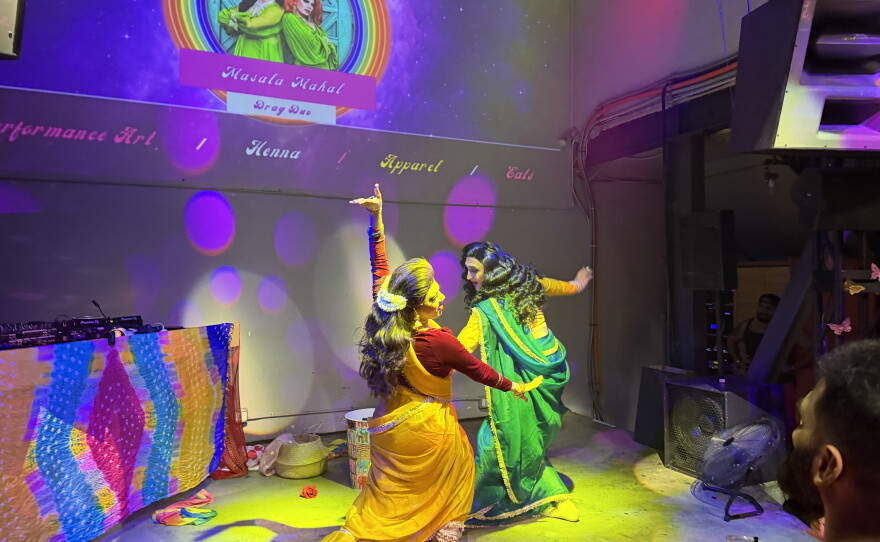
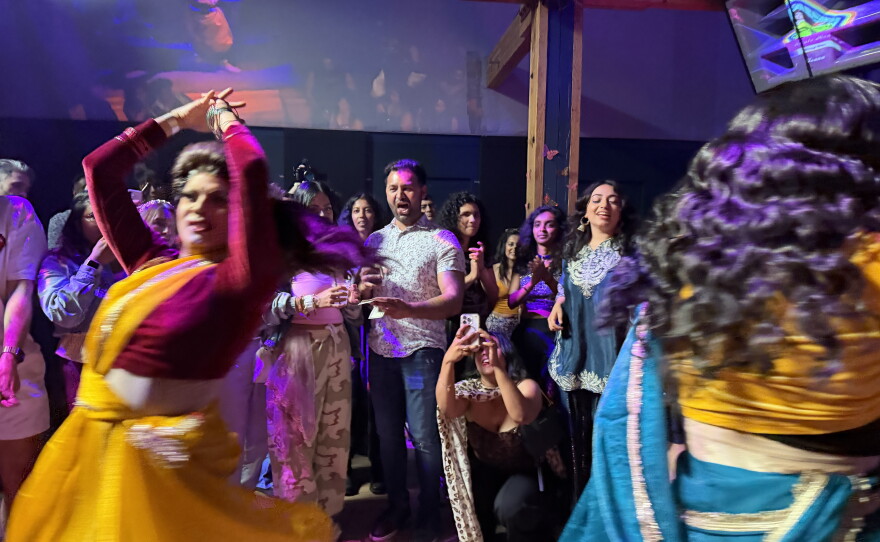
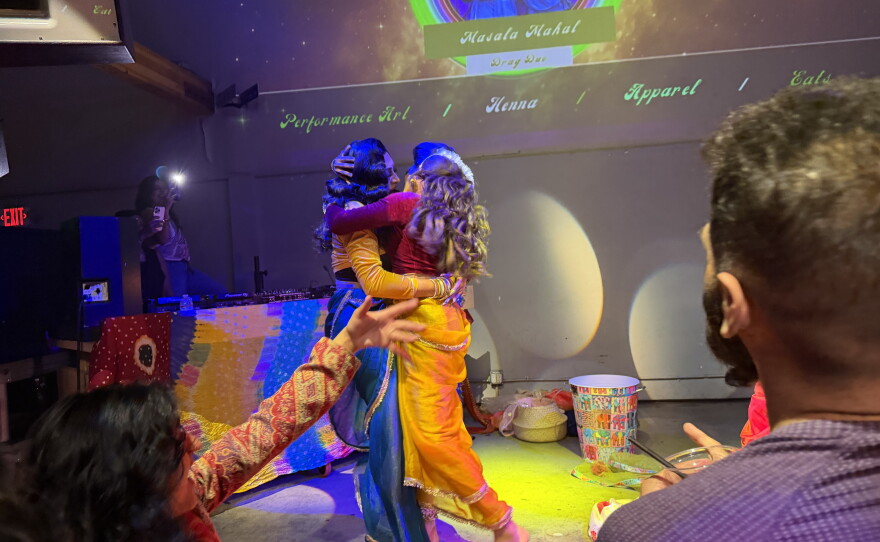
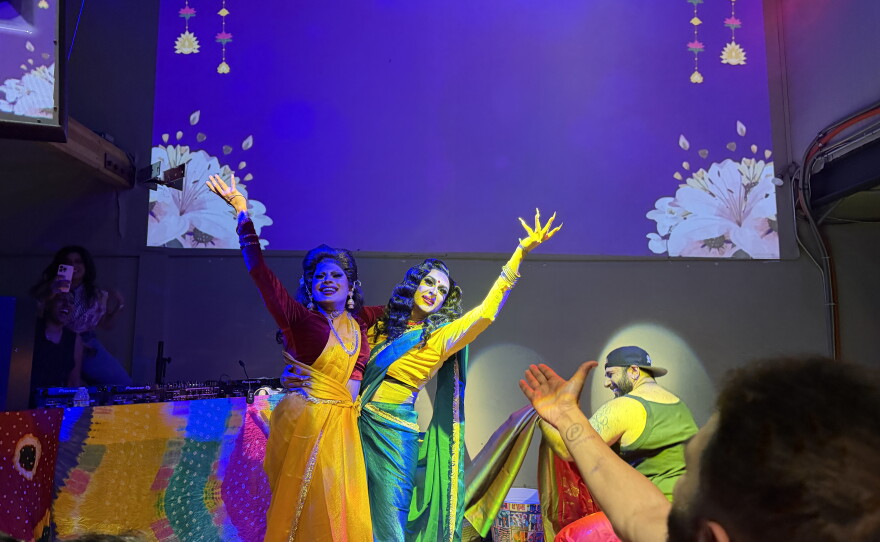
Out in the crowd, attendees like Atul Karmarkar, Neha Upadhyay, and Sumedh Naik are hungry for more of what they are seeing.
ATUL KARMARKAR: Personally I feel very very represented. We’ve grown up in a culture that doesn’t have drag as a concept. So to even see something of that sort where people are dancing to music that you identify with — It's very liberating. Very empowering.
NEHA UPADHYAY: Spaces like this really do celebrate us and make us feel like we have community, we have family.
SUMEDH NAIK: I think already Indian culture is known to be bold. And I feel like with Desi drag, it's bold, on steroids. So it really feels great to see that.
Jason says Masala Mahal is bigger than one show, one afternoon at Public Works.
SHARMA: There are so many Desi people and some of them are in the closet to their families. Some of them are very “on the down low.” They don't want anybody to know that they're LGBTQ+, right? And for them to see a Desi performer, doing a song they know — that’s that, “Oh my gosh, there is a home for me.” There is a community. Masala Mahal is here to bring visibility to the queer South Asian community, because it's extremely underrepresented.
Raj agrees.
SHARMA: I hope we give other people strength to come out and do stuff and it’s like a legacy almost at this point. Maybe it's a temple. Come and see the queens, and then see yourself in them.
The queens strike a pose, take a bow and leave the stage after what us desis would call a “masale-dar” performance. A performance bursting with so much flavor because it has everything.