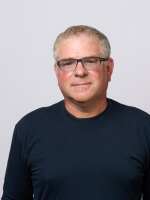
KALW Speaks: The Next 85 Series invites the KALW community to write essays about how their own family histories align with the good and bad of the American story, and what the last 85 years of KALW allows us to root ourselves in as we look to the future.
In the early twentieth century, both my mother’s and father’s families first came to the United States. They—my great-grandparents—left various parts of Eastern Europe to escape the Tsar, the Cossacks and their pogroms, landing in New York and New Jersey.
My grandparents, who were either born here or born just before the crossing, came through the Great Depression and two world wars, labor movements and many other fights for democracy, and somewhere along the way found each other and got married. They then gave birth to my parents. My parents, in turn, met and had my siblings and me.
I'm a third-generation American. In elementary school I celebrated the bicentennial. We, a multi-racial group of public school kids whose families had all come from other places, watched and heard stories about the American Revolution and its ideals, and were asked to imagine ourselves in them.
This July, our country turned two hundred and fifty. The official version of that anniversary was fireworks and fistfights, auto-racing and ICE raids, and the Declaration read aloud again. My kids, who attend multi-racial public schools in San Francisco, watched and heard stories about the American Revolution and its ideals, and then were asked to talk about how as a nation we have still not lived up to those ideals.
KALW, where I work, is also celebrating an anniversary. The anniversary we mark is different: eighty-five years of putting a live microphone in front of people the rest of the culture often doesn't listen to, and letting them talk in their own words, on the record.
Somewhere soon after that crossing, my great-grandfather Mordecai Kokoshky became Max Kass. But my family, while not always wanted, did not have to fight to be let into this country. They fought to get here, yes, and they fought to make it, but the doors were open.
My parents—born in 1939—came of age in the civil rights, free speech, and anti-war movements, and are, for the most part, good old-fashioned lefties. My father was a human rights and environmental attorney who helped define modern environmental law. My mother taught in public schools and spent her life fighting for women, including a debate appearance on New York public radio arguing for the Equal Rights Amendment. Both of them had chances their own parents never had, and they spent those chances the way good old-fashioned lefties did: at the March on Washington, in campaign offices for one candidate after another, and door-to-door canvassing for a New York mayoral race, where my father met Rita Schwerner, the widow of one of three men murdered in Mississippi in 1964 for registering Black voters. He still remembers that conversation clearly. I asked if by any chance she was related to Michael Schwerner, he texted me this morning. She said he was her husband. I said let’s not talk about this election; I just want to say how much I admired your husband for his courage. She seemed very alone in that dark apartment, he says.
My great-grandparents got in and stayed. My grandparents and parents found their voices and work that meant something to them. They found home. They taught us to keep pushing.
There were significant bumps along the way. My great-grandmother, who I never knew, spent fifty years institutionalized for what would now be recognized and treated as postpartum depression. But it was 1909. She never learned English. She spoke Yiddish, and for most of those fifty years the doctors treating her heard that Yiddish as the noise of a disordered mind.
KALW was built, in its own small way, at the same time that my family was settling in. Born from an idea at the 1939 World's Fair, we first went on air September 1941, out of Samuel Gompers Trades School, as part of the San Francisco Unified School District. The first FM station west of the Mississippi and one of the first educational stations in the country, KALW has always had an operating theory: that the version of a democracy worth having is the one that goes and gets the voices sitting outside its normal frequency range, instead of waiting for them to learn to sound acceptable first.
I moved to California over 30 years ago, the first in my family’s history to do so. I am the Executive Director of this very Bay Area station now, three generations after Mordecai Kokoshky traded his name for entry, one generation after my parents decided that entry came with a debt attached, and some unrecorded number of years after a woman said something true in a language nobody on staff would learn. That throughline is likely not unusual, and I'm glad that it found me.
The American promise was never that difference disappears into one acceptable sound. As much as the “great American melting pot” was part of the mythos, at its best, the promise of this country is that differences get recorded and heard, rather than corrected. That is something that we at KALW fight for, every single day.
My great-grandmother spent fifty years saying true things in a language nobody on staff would learn. Nobody wrote it down or thought it was worth the effort of translation. That's one version of the promise, too: the raw material was there, and the room to hear it wasn't.
Eighty-five years ago, KALW was built on the opposite bet, that the room could be made, one live microphone at a time, for whoever the rest of the culture wasn't listening to yet. That's the throughline I inherited, and it's one version of the promise I know how to keep. For the next eighty-five years, the mic stays on.
I hope you join us on the journey. We can’t do it without you.