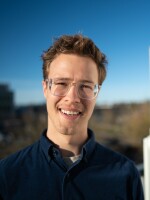
Patrick Batt’s eyes welled up as he remembered friends who died during the AIDS Crisis.
“ It was on the one hand an extraordinarily difficult time, and I don't remember crying as much then as I might do now because there was so much going on,” he said with tears in his eyes.

Batt, the owner of Auto Erotica bookstore in San Francisco’s Castro neighborhood, spoke at an event convened by KALW’s Travis Raburn. It was a multigenerational reflection on the Gay Rights Movement including Reverend Jim Mitulski and Paul Aguilar.
As the panel looked back on both tragedy and resilience, Mitulski described San Francisco as a place where people found their self-identity and community.
“San Francisco is more than just a geographical location,” said Mitulski. “It's a spiritual location too. You come here, and you discover who you are, and then you meet other people who are on that journey too.”

San Francisco’s LGBTQ+ activism runs deep, actually predating New York’s well-known 1969 Stonewall Uprising. The need for gay rights came into focus in the Bay in 1965, after a New Year’s eve police raid at a permitted drag show co-hosted by community members and, unusually, religious leaders at the California Hall located in the Tenderloin Neighborhood. Another event was the 1966 Compton’s Cafeteria Riot, where an officer attempted to arrest a drag queen at a Tenderloin diner and was confronted by patrons throwing dishware at him in protest.
At the KALW live event, Paul Aguilar remembers his own moment of self-discovery. A fourth-generation San Franciscan and the San Francisco AIDS Foundation’s community liaison for long-term survivors, Aguilar was in his teens when he joined the 1976 San Francisco Pride Movement and found his community.
“ I remember sneaking away,” he said, “riding my bike down there, and seeing this sea of people of different colors, and in different states of undress. And at some point, I realized, ‘Oh my God, these are my people.’"
Demonstrations built a network of support which became critical during the HIV/AIDS epidemic that emerged in the 1980s. As the US government failed to adequately address the crisis, the disease killed more than 700,000 Americans.

For Batt, the epidemic hit close to home.
“ If all of your friend group died, how would you deal with it?” he asked. “People need to hear firsthand before we all drop dead that it's what it was like. Because reading about it in a textbook, hearing about it in a classroom is totally different than sharing that information.”
Reverend Jim Mitulski became the pastor at the Metropolitan Community Church of San Francisco in 1986. He led his congregation through the height of the AIDS epidemic. He described how his faith guided a movement of community and healing.
“ I truly believe this, that God gathered those of us in gay churches,” Mitulski said. “So in the '60s and '70s, there would be a spiritual home to take care of peers, one another, people with AIDS in the '80s and '90s. I don't think God caused AIDS, all that nonsense. But I do think that God equipped us to take care of one another in a profound way.”

Things have changed dramatically for the better since then. In San Francisco, the most recent statistics show that fewer than 150 new cases of HIV have been diagnosed in each of the few years. But the panelists remain concerned. The House of Representatives Appropriations Committee is proposing to end funding for HIV prevention in the FY27 budget.
Aguilar worries that history could repeat itself.
“If I've fought this battle, young people shouldn't have to,” said Aguilar.