This story aired in the August 18, 2026 episode of Crosscurrents.
When you walk around San Francisco, you’re bound to notice the architecture, murals, and even graffiti… But some of the art surrounding you is not as obvious. Like a sign hanging above a neighborhood restaurant that transports you back in time.
While it’s an art form that’s largely been sidelined for decades, today hand-painted signage is having a moment here in the Bay Area. In this story we hear from one of the artists at the forefront of this renaissance.
Click the button above to listen!
Story Transcript:
REPORTER: Do you ever feel like you’re being followed? Not by a person but by an object. Hear me out, I don't mean in a paranoid way. But in a way where you notice something once, take note, and then you start to notice it everywhere. Just like angel numbers, but that was happening to me with a little pastel yellow scooter.
The first time I noticed it, I was walking in the Inner Sunset neighborhood. Down the street from the restaurant Casa Barajas on Lincoln, and then near Snowbird Cafe right off Irving St.
Then, days later, when I saw it again, I knew I had to try to figure out who it belonged to.
On one side of the scooter was a cartoon illustration of a girl with a top bun holding a giant paintbrush and toolbox, and on the other a bearded man sweeping along. Both figures cozied up next to red lettering that said "Signs by Meng.”

I realized I had seen this pair’s work all over the city. It seemed like whenever a space was being opened, it was Meng’s hands that were behind its first impression.
But who is Meng?
MICHELLE “MENG” NGUYEN: Like, I feel like as soon as I'm done with the project, I'm, like, onto the next one. Like, I can't even savor the last one. It's, like, almost like amnesia. Yeah. But I love all my children.
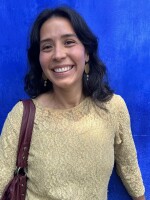
REPORTER: That’s Michelle Nguyen, the owner of Signs by Meng. Her “children” all have their own styles. Some are bold and modern, others are more rounded and retro — lettering and colors are never quite the same.
And that’s her partner in life and in art, Jeffrey Larrimore, who is playfully pushing a big red button — he says it’s their most important tool.
And one of the many wacky and colorful trinkets in their studio that reflects the sense of playfulness. They carry this energy into their partnership and artistic process.
Jeffrey jokingly refers to himself as her long-term assistant.
JEFFREY LARRIMORE: I only get paid in hugs and kisses.
REPORTER: I’m with them in their studio at Yosemite Place in the Bayview District, a historic three-story building that was once an old mattress factory. Now a home to dozens of artists. Whimsical hand-drawn lettering signs are plastered along their walls. Some are made by them, others by friends who also sign paint and live overseas. Every inch of the walls is covered with some kind of lettering inspiration — a corner shelf is full of vintage label packaging, stacked up high.

MICHELLE: It's been almost 15 years now, and I think we're getting somewhere.
REPORTER: Signs by Meng has sign-painted and rebranded businesses all across the Bay Area.
MICHELLE: We're working on a gym that's opening up in the Richmond called Ad Astra.
REPORTER: Branding for Konbini, a little Taiwanese convenience store that's on 24th and Harrison.
JEFFREY: We're painting signs for the mess hall that's opening up in Presidio... Tunnel Tops.
REPORTER: An extensive list that shows the scale of their projects: Red Boat Fish Sauce, Outta Sight Pizza, the beloved — now closed queer restaurant Friends and Family in Oakland, Unco Frank’s Hawaiian BBQ on Clement and most recently the long-awaited restoration of the iconic Castro Theatre sign…
Each finished piece gets logged in a digital map Michelle created. A trail of scattered breadcrumbs, where a completed project can be found as a red dot. The map, awash in red, reveals how the entire city carries their work.
Michelle looks for her favorite brushes to wash, while Jeffrey finishes cutting wood scraps. Before shutting down, the machine lets out a tired groan.
They aren’t afraid of giving each other honest feedback as they go; the pairing clearly works. Michelle tells me how this came to be.
MICHELLE: I met Jeff, or actually Jeff found me first, but I was working at Falletti Foods as a cashier and sign maker. He was freelancing at the time, so he would stalk me for three months before actually introducing himself.
REPORTER: At the time, Michelle was studying graphic design but chalked signage for her local grocery store. A hobby she never thought much about until she started dating Jeffrey, who already worked in graphic design. He suggested they go to New Bohemia, San Francisco’s renowned training spot, where sign painters learn and refine their trade.
JEFFREY: I was the one that was like, "We should take this class. This is cool. Like, let's try this.
MICHELLE: I feel like that's the main stepping stone for a lot of sign painters because there aren't a lot of shops.
REPORTER: Or institutions that teach people looking to learn the blue-collar trade of sign painting. With the unexpected announcement of California Academy of Art’s closure earlier this year, New Bohemia has become the go-to resource for people looking to learn.
MICHELLE: During this time, it's, you have to either do that or go to LA, 'cause there's, like, one of the last few trade tech schools that offer sign painting as a curriculum. Other than that, I feel like you have to, like, self-start basically.
REPORTER: Taking a workshop at the longest-running sign shop in San Francisco was the jumping-off point they needed.
MICHELLE: We both took a sign painting class at New Bohemia Signs, which Jeff pushed me to do because I wasn't super confident in sign making in that regard. 'Cause at the time I was doing, like, markers and chalk and stuff, and paint was just scary in my mind and super committal.
REPORTER: The permanence that first intimidated Michelle became something she started to crave. But school projects didn’t give her that.
MICHELLE: Design was cool, but I felt like there was always like a stopping point.
REPORTER: Creating designs for fake businesses to meet a deadline… kinda sucked.
MICHELLE: Whereas sign painting, there was like a clear end, and like a clear physical thing that I can see and visit that I made with my hands.
REPORTER: The two began experimenting, taking more classes and learning together.
JEFFREY: We live together. We eat together. We drive to work together. We paint next to each other. Like everything is together.
REPORTER: Including their first project that started their careers. Michelle and Jeffrey thought about approaching businesses with outdated storefront signage. One business came to mind. Kim Nguyen’s restaurant - Mộng Thu Café.
MICHELLE: It was around the same time me and Jeff got together. We're like, "Hey, she has a wall. She just got rid of her awning. Like, here's an opportunity for us to paint her sign too."
REPORTER: Mộng Thu Café, San Francisco’s Vietnamese comfort food spot, opened in 1993. Sitting in the heart of Little Saigon in the Tenderloin District, Michelle was no stranger to this place; the once bright pink banner out front was a fixture of her childhood since she was five. Because the cafe’s owner - Kim Nguyen - is her mom.

MICHELLE: And then, um, the whole time my mom was just like, "What are you doing? What is this for? Why?" "Why are you wasting your time?" Like, she saw no purpose in it.
REPORTER: But Michelle and Jeffrey knew the rebranding of her storefront, while tedious to Mrs. Nguyen, would be good for business. It was already a staple to its surrounding Vietnamese community — its cozy interior and home cooking quickly gave families and elders a piece of home.
But Jeffrey and Michelle knew more people would enjoy it…if they just knew about it. So, along with the new signage, they created a website along with a Yelp page that would redirect online foodies. It was the first time the business had an internet presence. In many ways, it was the modernization the small business needed.
JEFFREY: She didn't see the value in it until people started being like, "Oh, well, on your website," and she went, "Oh. Oh yeah, update that.”
MICHELLE: She was so used to catering to her regulars, which is usually like, you know, Vietnamese people in the neighborhood. And then like she slowly started seeing new people, different people, younger people, and she's like, "Oh, maybe, maybe you two are onto something," you know?
REPORTER: The glow-up of Mộng Thu Café’s signage mirrors the trend of Bay Area businesses choosing custom hand-painted signs. A sign painting renaissance that Jeff and Michelle have helped reignite.
The craft’s glory days harken back to the early to mid-1900s, when Bay Area businesses relied on this traditional blue-collar trade. Just after the 1906 earthquake, businesses had to start over and find new ways to advertise alongside its destruction. Quickly built commercial buildings stood next to newly empty lots, which meant more space for huge hand-painted advertisements and custom signs.
This style was popular until large-format printing took over in the mid-1950s.
Then in the 80s, that got disrupted by:
VINYL!
Apple launched software called The Print Shop. It allowed folks with no graphic design experience to create signage.
And Vinyl shops followed; machines could print your design faster and cheaper — computer-cutting didn’t need hours to paint. The once sought-out trade now left painters out of jobs. But aesthetically, the designs weren’t always…great.
JEFFREY: It was easy, it was quick, and then people realized like, people are not really thinking; they're just hitting print.
REPORTER: But there was always a limit; original vinyl cutters allowed for more but still felt clunky.
JEFFREY: You can't find a vinyl shop in the city. They exist, but like it's funny because I think now when people think they need signs, they think hand-painted signs first.
REPORTER: Jeffrey adds that the resurgence in sign painting won’t go down without a fight. He thinks there’s value to something that can’t easily be printed.
Michelle and Jeffrey’s work is proof of that. Their style harkens back to the simple, bold approach of the pre-vinyl era! It’s modern lettering, but with the spirit of the past! Michelle says that vintage signage and packaging is their biggest blueprint!
Owners wanted their signs to signal that they were intentional about their presence as part of the neighborhoods they’re joining. 10 years later, and 85 re-worked signs to their name. They’re intentional about who they choose to work with.
When approached with a project, Michelle and Jeffrey ask themselves:
MICHELLE: Like, is it worth it for them? Is it worth it for us?
JEFFREY: We've turned down cool jobs because we're like, “This does not sound like fun to us interacting with you. Like, we're gonna show up and just be, like, machines.” And sometimes we do take those jobs 'cause we need the money, but if we can say no to them, we will try.

REPORTER: And in a city where AI can harvest work to create generic, oftentimes glitchy pieces, people don’t want things that are just spit out by a computer. The patience it takes to sand, prep, and paint wins.
JEFFREY: We've turned down jobs that have been AI. We're like, "We won't paint that." Like, it's not something we can paint, or we wanna enjoy painting.
REPORTER: Giving sign painters an AI-made design sounds like a cruel joke, but it’s a reality that both Michelle and Jeffrey have to navigate. But they both tell me that some businesses are so afraid of customers thinking something is “AI-made", that owners openly welcome all human mistakes.
MICHELLE: Yeah, people would request it sometimes. Like, "Can you paint it like not as perfect?"
REPORTER: As strange as that might sound, it reflects how businesses continue to see the importance of handcrafted signage and the investment in human hands.
MICHELLE: It just shows how much they value that craft, but also how much they want to invest in their own business, you know? Mm-hmm. It just feels good. Ha- handmade anything, you know?
REPORTER: The preservation of this craft is a huge motivator for Michelle and Jeffrey. And they honor that in their work. And they aren’t the only ones showing reverence for the craft in their daily labor. They’re friends with a whole crew of 30 to 40 sign painters in the Bay Area.
MICHELLE: Like, we're all homies. We're always rooting for each other. We're bidding on the same jobs, but then when we find out who got it, we're like, "Ah, I'm glad it went to you 'cause that looks so good."
REPORTER: The success of Signs by Meng and their fellow sign painters is a good reminder that the craft isn’t disappearing anytime soon; it’s just evolving.