

- Job Action Day
- Republican Elephant Day
- Hug A Bear Day
- Notary Public Day
- Bittersweet Chocolate with Almonds Day
- Solidarity Day-Bangladesh
- Accord & Reconciliation Day-Russia
- Thanksgiving Day-Liberia
- On This Day
- 1874 --- The mighty elephant, trumpeter of the jungle and circus entertainer -- lumbering, powerful fieldworker and mode of transportation -- became a symbol of the Republican Party. Thomas Nast, a political cartoonist for Harper’s Weekly, created a satirical drawing of an elephant about to fall into a giant hole. The elephant represented the Republican party and was used in reference to Ulysses S. Grant’s possible bid for a third term. Grant was a Republican. The symbol stuck and has been used ever since to represent the G.O.P. both in political cartoons and by the party itself.
- 1876 --- The outcome of the election of 1876 was not known until the week before the inauguration itself. Democrat Samuel Tilden had won the greater number of popular votes and lacked only one electoral vote to claim a majority in the Electoral College. Twenty disputed electoral votes, however, kept hopes alive for Republican Governor Rutherford B. (Birchard) Hayes of Ohio. When all was said and done, the Electoral College selected Hayes as the 19th President of the United States.
- 1637 --- Anne Hutchinson, the first female religious leader in the American colonies, was banished from the Massachusetts Bay Colony for heresy.

- 1837 --- In Alton, Illinois, abolitionist printer Elijah P. Lovejoy was shot to death by a mob (supporters of slavery) while trying to protect his printing shop from a third destruction.

- 1885 --- At a remote spot called Craigellachie in the mountains of British Columbia, the last spike is driven into Canada's first transcontinental railway.

- 1893 --- Passage of a referendum made Colorado the first state to grant women the right to vote.

- 1911 --- Marie Curie became the first multiple Nobel Prize winner when she was given the award for chemisty eight years after garnering the physics prize with her late husband, Pierre. (She remains the only woman with multiple Nobels and the only person to receive the award in two science categories.)

- 1916 --- Republican Jeannette Rankin of Montana became the first woman elected to Congress.

- 1917 --- Russia's Bolshevik Revolution took place as forces led by Vladimir Ilyich Lenin overthrew the provisional government of Alexander Kerensky.


- 1940 --- Only four months after its completion, the Tacoma Narrows Bridge in Washington State suffers a spectacular collapse. When it opened in 1940, the Tacoma Narrows Bridge was the third-longest suspension bridge in the world. Built to replace the ferry system that took commuters from Tacoma across the Tacoma Narrows to the Gig Harbor Peninsula, the bridge spanned 2,800 feet and took three years to build. To save cost, the principle engineer, Leon Moisseiff, designed the bridge with an unusually slender frame that measured 39 feet and accommodated just two vehicular lanes. The Tacoma Narrows Bridge opened with great fanfare on July 1, 1940. Human traffic across the waters of the Tacoma Narrows increased dramatically, but many drivers were drawn to the toll bridge not by convenience but by an unusual characteristic of the structure. When moderate to high winds blew, as they invariably do in the Tacoma Narrows, the bridge roadway would sway from side to side and sometimes suffer excessive vertical undulations. Some drivers reported that vehicles ahead of them would disappear and reappear several times as they crossed the bridge. On a windy day, tourists treated the bridge toll as the fee paid to ride a roller-coaster ride, and the Tacoma Narrows Bridge earned the nickname "Galloping Gertie." Attempts were made to stabilize the structure, but they were in vain. On November 7, with a steady wind blowing at 42 mph, the roadway began to twist back and forth in an increasingly violent fashion. Before closing the span, the toll keeper on the bridge's west side let one last motorist pass, Tacoma News Tribune copy editor Leonard Coatsworth. Halfway across the bridge, Coatsworth lost control of his car. When the roadway tipped so sharply that it seemed his car would topple off, he decided to flee on foot. He tried to retrieve his daughter's black cocker spaniel from the back seat of the car, but the dog snapped at him and refused to budge.
 Coatsworth ran to safety and called the Tribune,who dispatched a reporter and photographer to the scene. Tribune photographer Howard Clifford was the last man on the bridge before the center span broke off at 11 a.m. and plunged 190 feet into the turbulent Tacoma Narrows. Trapped on the suddenly destabilized side spans, he narrowly avoided being thrown off and ran to safety.

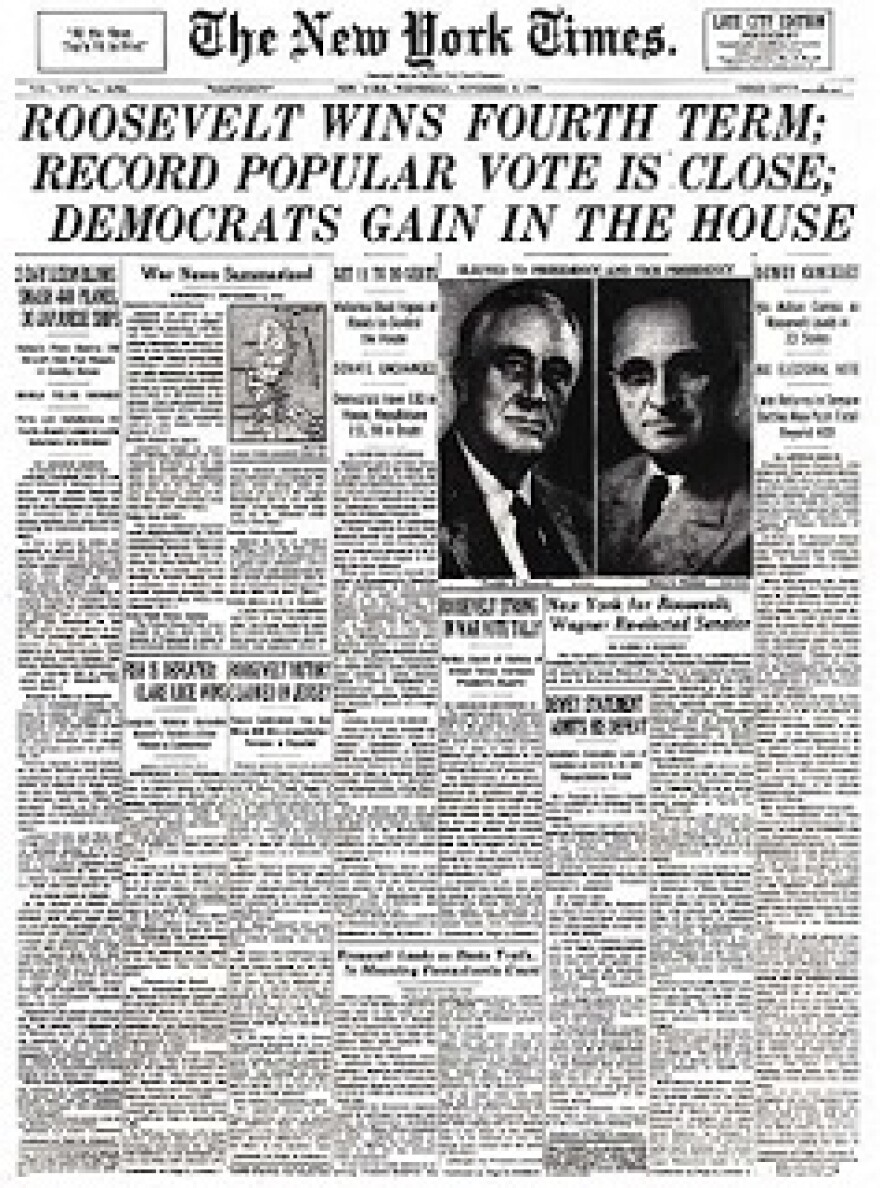
- 1944 --- U.S. President Franklin D. Roosevelt won a fourth term, defeating Republican Thomas E. Dewey. F.D.R. was the only President to be elected for more than two terms; he was elected four times with three different Vice Presidents. He died in office on April 12, 1945, after serving 53 days of his fourth term.
- 1962 --- Richard M. Nixon, who failed in a bid to become governor of California, held what he called his last press conference, telling reporters, "You won't have Nixon to kick around anymore."

- 1963 --- The comedy "It's a Mad, Mad, Mad, Mad World" premiered in Hollywood.

- 1963 --- Elston Howard, of the New York Yankees, became the first black player to be named the American League's Most Valuable Player.

- 1965 --- The Pillsbury Doughboy, 'Poppin' Fresh,' was born. He made his debut in a commercial for crescent rolls.

- 1966 --- Secretary of Defense Robert S. McNamara faces a storm of student protest when he visits Harvard University to address a small group of students. As he left a dormitory, about 100 demonstrators shouted at him and demanded a debate. When McNamara tried to speak, supporters of the Students for a Democratic Society shouted him down. McNamara then attempted to leave, but 25 demonstrators crowded around his automobile so that it could not move. Police intervened and escorted McNamara from the campus.


- 1967 --- President Lyndon B. Johnson signed a bill establishing the Corporation for Public Broadcasting.

- 1967 --- The Selective Service Commission announced that college students arrested in anti-war demonstrations would lose their draft deferments.

- 1972 --- President Richard M. Nixon and Vice President Spiro Agnew were reelected in a landslide victory, 60.7% to 37.5%, over Democrats George McGovern and R. Sargent Shriver.

- 1973 --- The U.S. Congress over-rode President Nixon's veto of the War Powers Act, which limits a chief executive's power to wage war without congressional approval.

- 1985 --- The Colombian army stormed the country's Palace of Justice. The siege claimed the lives of 100 people, including 11 Supreme Court Justices. The Palace had been seized by leftist guerrillas belonging to the April 19 Movement.

- 1987 --- Tunisia's president Habib Bourguiba was overthrown. He had been president since the country's independence in 1956.

- 1988 --- John Fogerty won his self-plagiarism court battle with Fantasy Records. The label claimed Fogerty copied his own song, "Run Through The Jungle" when he wrote "The Old Man Down The Road".

- 1989 --- In New York, former Manhattan borough president David Dinkins, a Democrat, is elected New York City's first African American mayor, while in Virginia, Lieutenant Governor Douglas Wilder, also a Democrat, becomes the first elected African American state governor in American history.

- 1991 --- Actor Paul Reubens, a.k.a. Pee Wee Herman, pled no contest to charges of indecent exposure. Reubens had been arrested in Sarasota, FL, for exposing himself in a theater.

- 1991 --- Earvin "Magic" Johnson stuns the world by announcing his sudden retirement from the Los Angeles Lakers, after testing positive for HIV, the virus that causes AIDS.

- 2000 --- Republican George W. Bush was elected president over incumbent Democratic Vice President Al Gore, though Gore won the popular vote by a narrow margin. The winner was not known for more than a month because of a dispute over the results in Florida.

- 2000 --- Hillary Rodham Clinton made history as the first president's wife to win public office. The state of New York elected her to the U.S. Senate.


- Birthdays
- Marie Curie
- Dame Joan Sutherland
- Leon Trotsky
- Albert Camus
- Biolly Graham
- Al Hirt
- Johnny Rivers
- Joni Mitchell
- 311th Day of 2014 / 54 Remaining
- Winter Begins in 44 Days
- Sunrise:6:42
- Sunset:5:04
- 10 Hours 22 Minutes
- Moon Rise:6:02pm
- Moon Set:7:24am
- Moon Phase:99%
- Next Full Moon December 6 @ 4:27am
- Full Cold Moon
- Full Long Nights Moon
During this month the winter cold fastens its grip, and nights are at their longest and darkest. It is also sometimes called the Moon before Yule. The term Long Night Moon is a doubly appropriate name because the midwinter night is indeed long, and because the Moon is above the horizon for a long time. The midwinter full Moon has a high trajectory across the sky because it is opposite a low Sun.
- Tides:
- High Tide:10:13am/11:52pm
- Low Tide:4;10am/5:01pm